
The Westerkerk (Western Church) stands as a primary example of religious architecture from the Dutch Golden Age. Situated along the Prinsengracht, this structure was designed to accommodate the growing Protestant population of Amsterdam during the city’s rapid expansion. As you walk through the Jordaan district, the church serves as a constant orientation point due to its height and central location. The building is not only a monument of stone and wood but also a repository of Dutch cultural memory, housing historical organs and commemorating significant residents of the past. Understanding the Westerkerk (Western Church) provides insight into the architectural, social, and religious shifts that defined 17th-century Amsterdam.
In this blog:
The Historical Origins and Construction
The construction of the Westerkerk (Western Church) began in 1620, following the designs of the renowned architect Hendrick de Keyser. This project was part of a larger urban plan to provide the newly developed “Grachtengordel” (canal belt) with four major churches, positioned at the cardinal points. While the Noorderkerk and Zuiderkerk served other sectors, the Westerkerk (Western Church) was intended for the wealthiest citizens living along the Keizersgracht and Prinsengracht. After Hendrick de Keyser passed away in 1621, his son, Pieter de Keyser, oversaw the completion of the project. The church was officially inaugurated for services on June 8, 1631.
The building process faced several logistical challenges, typical of 17th-century Amsterdam. Because the city is built on peat soil, the massive weight of the church required a foundation of thousands of wooden piles. The choice of a Protestant “basilica” design was a departure from earlier Catholic traditions, focusing the interior layout on the pulpit rather than the altar. This shift reflected the theological priorities of the Reformation, where the spoken word took precedence over visual liturgy. Over the decades, the Westerkerk (Western Church) became the most important Protestant church in the city, frequently hosting official state ceremonies and serving as a focal point for the local community.
Tip: The official address of the building is Prinsengracht 279, 1016 GW Amsterdam, and it is registered as a national monument under Rijksmonument number 4242.
How to get there?
Plan my journey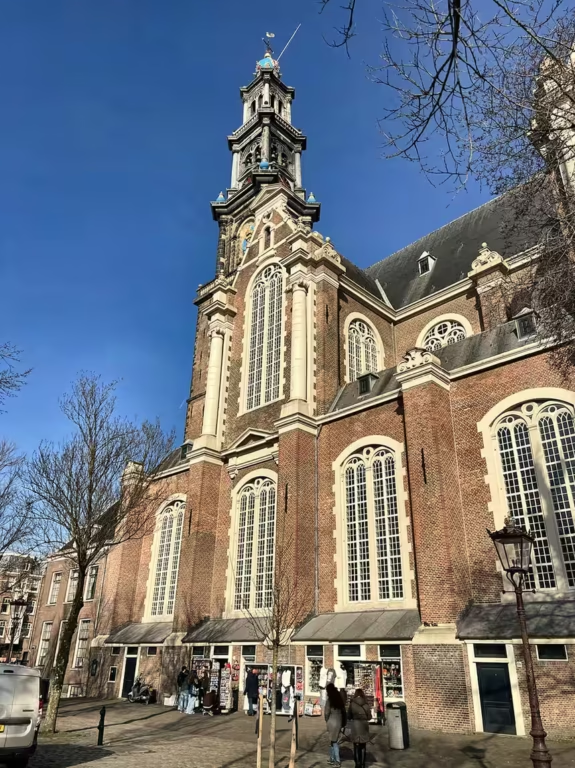


Architectural Characteristics of the Dutch Renaissance
The Westerkerk (Western Church) is widely considered the masterpiece of Hendrick de Keyser. It features a floor plan in the shape of two Greek crosses, creating a spacious and light-filled interior. Unlike the dark, ornate Catholic churches of the previous century, this Protestant structure utilized large windows and white-plastered walls to emphasize clarity and simplicity. The exterior combines traditional red brick with decorative elements of Bentheimer sandstone, a hallmark of the Dutch Renaissance style. You can observe the use of classical orders, such as Ionic and Doric columns, integrated into the facade and interior supports.
The dimensions of the church were significant for its time. It measures approximately 58 meters in length and 29 meters in width. The interior is divided by large arches that support the wooden barrel vaults. Because stone vaults would have been too heavy for the wooden pile foundation, the architects chose painted wood for the ceiling, which also provided superior acoustics for the organ and congregational singing. The massive organ, which was added later in the 17th century, features shutters painted by Gerard de Lairesse, depicting scenes from the Bible and musical history. These architectural choices ensured that the Westerkerk (Western Church) remained a functional and visually impressive space for centuries.
Tip: The main organ of the church was commissioned in 1682 and the paintings on the organ shutters were completed by Gerard de Lairesse in 1686.
Westerk church Amsterdam.
The Burial of Rembrandt van Rijn and Historical Records
One of the most significant historical facts associated with the Westerkerk (Western Church) is that it contains the remains of the painter Rembrandt van Rijn. Rembrandt died on October 4, 1669, and was buried in the church four days later. Because he was impoverished at the end of his life, he was buried in a “huurgraf” (rented grave), which was a common practice for those who could not afford a private family plot. According to the custom of the time, the remains in such graves were often removed after a period of twenty years to make room for new burials. Consequently, the exact location of Rembrandt’s bones within the church is no longer known.
Despite the loss of his physical remains, the church maintains several memorials to the artist. In 1906, on the 300th anniversary of his birth, a commemorative plaque was installed on one of the pillars near the northern aisle. This plaque serves as the primary site for visitors to pay their respects. Historical burial registers from the Westerkerk (Western Church) also record the interment of other notable figures, including Rembrandt’s son Titus van Rijn and his partner Hendrickje Stoffels. These documents are preserved in the Amsterdam City Archives, providing a factual timeline of the residents and notable individuals who found their final resting place within these walls.
Tip: Rembrandt van Rijn was buried in the Western Church on October 8, 1669, as documented in the official church burial register.

Anne Frank House – A Powerful Place of History
Along the Westerkerk, the Anne Frank House marks the location where Anne Frank and her family hid in the Secret Annex during the Second World War. Today the building is one of Amsterdam’s most visited museums, preserving the rooms where Anne wrote her famous diary.
A remarkable fact is that the original movable bookcase that concealed the entrance to the Secret Annex is still preserved inside the museum. Visitors can walk through the hidden rooms and learn more about Anne Frank’s diary, one of the most widely read personal stories of the war.
The Westertoren: Technical Specifications and the Imperial Crown
The tower of the Westerkerk (Western Church), known as the Westertoren, is the tallest church tower in Amsterdam, reaching a height of 85 meters. While the church itself belongs to the Protestant community, the tower is the property of the municipality of Amsterdam. This arrangement dates back to the Napoleonic era when the city took over the maintenance of towers for civil purposes, such as fire watching and timekeeping. The tower is constructed in several tiers, transitioning from a square brick base to an octagonal wooden structure covered in lead and stone.
At the very top of the Westertoren sits the Blue Crown, which is the Imperial Crown of Holy Roman Emperor Maximilian I. In 1489, the emperor granted Amsterdam the right to use his crown in its coat of arms as a reward for the city’s financial and political support. You can see this crown reproduced in high detail at the summit of the tower, finished in blue and gold. The tower also houses a heavy set of bells and a carillon that rings out across the city. The architectural style of the tower differs slightly from the church, as it was completed later and reflects a more ornate, vertical emphasis that allows it to be seen from several kilometers away.


The Bells and the Carillon of the Western Church
The soundscape of the Jordaan district is defined by the bells of the Westerkerk (Western Church). The tower contains a carillon that was originally cast by the famous bell founders François and Pierre Hemony in 1658. Over the centuries, the carillon has been expanded and restored to ensure it remains in tune. Today, the carillon consists of 51 bells, ranging from very small bells to a massive “bourdon” that weighs over 7,500 kilograms. The bells are used not only for marking the hour but also for weekly concerts performed by the city carillonneur.
The mechanics of the carillon are a feat of 17th-century engineering. A large rotating drum with adjustable pegs triggers the hammers to strike the bells at specific intervals. This automated system allowed the city to broadcast music and time signals to the population long before the invention of personal watches or radios. During the Nazi occupation in World War II, many church bells in the Netherlands were confiscated and melted down for the war effort. However, the bells of the Westerkerk (Western Church) were spared due to their historical and cultural significance, allowing the original Hemony craftsmanship to survive to the present day.
Tip: The heaviest bell in the tower, the bourdon, was cast by François Hemony in 1658 and weighs approximately 7,509 kilograms.

Discover the story behind Westerkerk Amsterdam
The Westerkerk (Western Church) is a prominent 17th-century Protestant church located in Amsterdam. Known for its Dutch Renaissance architecture and the 85-meter Westertoren, it serves as the final resting place of Rembrandt van Rijn and remains an active religious and cultural landmark in the city’s historic center.
Cultural Significance in Literature and Media
The Westerkerk (Western Church) has a profound connection to the history of the Holocaust through the diary of Anne Frank. The Frank family lived in the “Achterhuis” (Secret Annex) at Prinsengracht 263, which is located only a short distance from the church. In her diary, Anne Frank frequently mentions the sounds of the church bells and the clock of the Westertoren. For the inhabitants of the annex, who were forced to remain silent and hidden, the chiming of the bells was a vital link to the outside world and a source of comfort. She specifically noted how the clock chimed every quarter-hour, providing a sense of time during her two years in hiding.
In addition to its literary significance, the church has appeared in numerous films and documentaries about Amsterdam. Its distinct silhouette is often used as a visual shorthand for the city’s historical center. The square in front of the church, the Westermarkt, also holds cultural weight. It is home to the Homomonument, a memorial consisting of three pink granite triangles that commemorates persecuted LGBTQ+ individuals. This placement highlights the church’s role as a backdrop for the city’s ongoing dialogue regarding human rights and historical reflection. The proximity of the church to both the Anne Frank House and the Homomonument makes it a central site for modern historical tourism.
Take a virtual tour with Google Streetview!
Visiting the Western Church: Current Functions and Access
Today, the Westerkerk (Western Church) remains a vibrant part of the Amsterdam community. It is an active Protestant church with Sunday services that are open to everyone. Beyond its religious function, the church serves as a venue for classical music concerts, choir performances, and community events. Because of its large interior and excellent acoustics, it is a preferred location for organ recitals. Visitors can enter the church during designated opening hours to view the architecture, the Rembrandt memorial, and the historic organs.
While the church is accessible, the Westertoren requires a separate arrangement for those who wish to climb it. Guided tours of the tower are offered during the summer months, allowing you to ascend the narrow stairs and view the city from the balconies near the bells. These tours provide technical information about the construction of the tower and the operation of the carillon. Inside the church, you will find information panels in multiple languages that detail the history of the building and its residents. Maintaining the church requires significant resources, and the foundation often hosts fundraising events to support the ongoing restoration of the stonework and interior fixtures.
Frequently Asked Questions (FAQ)
Where is Rembrandt buried in the Westerkerk?
Rembrandt van Rijn was buried in a rented grave in the Westerkerk (Western Church) in 1669. Because it was a common grave, his remains were later removed, and the exact location is unknown. However, there is a commemorative plaque on the north wall of the church marking his burial.
How high is the Westertoren?
The Westertoren is 85 meters tall, making it the highest church tower in Amsterdam. It is topped by the Imperial Crown of Emperor Maximilian I.
Can I visit the church during a service?
You are welcome to attend the religious services on Sunday mornings, but tourist sightseeing and photography are not permitted during these times. For general visits, it is best to check the official opening hours on the church website.
Is the Westerkerk the same as the Oude Kerk?
No, the Westerkerk (Western Church) was built in the 17th century in the Renaissance style, while the Oude Kerk is much older, dating back to the 13th century, and is built in the Gothic style. They are located in different parts of Amsterdam’s historic center.
How many bells are in the carillon?
The carillon of the Westerkerk (Western Church) currently consists of 51 bells. The original bells were cast in 1658 by the Hemony brothers.
Sources
- Amsterdam City Archives. (2024). Begraafregister Westerkerk: Burial of Rembrandt van Rijn.
- Monumentenregister. (2024). Rijksmonument 4242: Westerkerk Prinsengracht 279.
- Stichting Westerkerk Amsterdam. (2024). History and Architecture of the Western Church.
- City of Amsterdam. (2024). The Westertoren: Maintenance and History.
- Anne Frank House. (2024). The Secret Annex and the Westerkerk.

Leave a Reply