
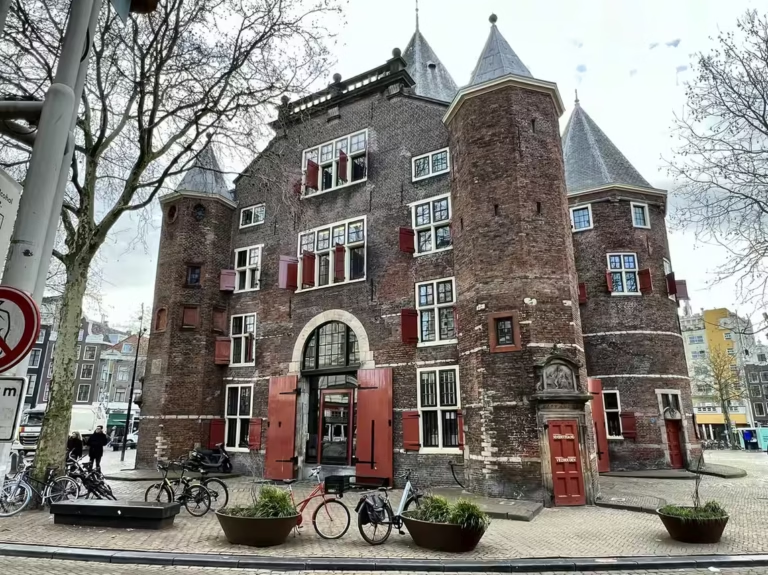
Located at the center of Nieuwmarkt, De Waag (The Weigh House) is a building that has successfully adapted its function to the changing needs of Amsterdam over five centuries. Initially known as the Sint Antoniespoort, it served as a crucial part of the medieval city walls. As Amsterdam expanded in the 17th century, the gate lost its defensive purpose and was repurposed as a public weigh house. This shift marked the beginning of a new era where guilds, scientists, and merchants converged within its brick walls. Today, the building remains a focal point for those interested in the historical development of the Netherlands.
In this blog:
The Medieval Origins of the Sint Antoniespoort
The structure currently known as De Waag (The Weigh House) began its existence as one of the primary gates in the second medieval city wall of Amsterdam. Construction started in the late 15th century when the city required more robust defenses against external threats. At that time, the building was situated at the end of the Zeedijk and served as the land gate for travelers arriving from the east. The city wall connected this gate to other fortifications, such as the Schreierstoren, creating a defensive perimeter that protected the growing merchant town.
Historical records indicate that the gate was completed around 1488. It was a massive brick construction designed to withstand sieges, featuring heavy doors and narrow windows for defense. As the city grew rapidly during the 16th century, the urban landscape changed. The residential and commercial areas expanded beyond the original medieval boundaries, rendering the internal defensive walls obsolete. By the end of the century, the Sint Antoniespoort no longer stood at the edge of Amsterdam but had become an obstacle to traffic and urban flow within a larger city.
Tip: The foundation stone of the Sint Antoniespoort, now known as De Waag (The Weigh House), was officially laid on April 28, 1488.
The decision to preserve the gate rather than demolish it was based on practical and economic considerations. While other parts of the city wall were removed to make room for new canals and housing, the gate was viewed as a substantial structure that could be repurposed for civic administration and trade. This preservation allowed the building to survive into the modern era, making it a rare example of 15th-century secular architecture in the capital.
How to get there?
Plan my journey


Transformation to De Waag (The Weigh House) in 1617
In 1617, the municipal authorities of Amsterdam initiated a major renovation of the former Sint Antoniespoort. The core of the gate was filled in with a courtyard, and the entire structure was topped with a roof, creating a large indoor space. This transformation was necessitated by the growing demand for a central location where goods could be weighed for tax purposes. Prior to this, weighing occurred at smaller, less centralized locations. The building was officially designated as De Waag (The Weigh House) to serve the merchants operating in the nearby harbor and markets.
The transition to a weigh house was not merely a change in name. The internal layout was modified to accommodate large scales, known as “waagschalen,” which were used to weigh heavy commodities such as anchor cables, cheese, spices, and whale oil. The accuracy of these scales was strictly regulated by the city to ensure fair trade. Merchants were required to bring goods weighing more than ten pounds to the building to be weighed by official weigh-masters. This process provided the city with a significant source of revenue through the “waaggeld” or weighing tax.
Tip: De Waag (The Weigh House) is registered in the Dutch national heritage database under Rijksmonument number 3848.
The location on the Nieuwmarkt square was ideal for this function. The square was created by filling in part of the city moat that previously ran alongside the wall. This provided a large open area where carts and boats could easily transport goods to and from the building. The square itself became a bustling marketplace, and De Waag (The Weigh House) served as its administrative and physical heart. The building’s presence reinforced Amsterdam’s position as a dominant global trade hub during the Dutch Golden Age.
The Waag 360 degrees
The Guilds and the Theatrum Anatomicum
One of the most distinct features of De Waag (The Weigh House) is the historical presence of various professional guilds. In the 17th century, several guilds were granted space in the towers of the building. These included the guilds of the surgeons, masons, smiths, and painters. Each guild had its own entrance, often decorated with symbols representing their trade. The surgeons’ guild is perhaps the most famous of these occupants due to its association with scientific advancement and the fine arts.
The surgeons established the Theatrum Anatomicum in the central tower of the building. This was a dedicated space where public dissections were performed, primarily during the winter months when lower temperatures helped preserve the bodies. These dissections were educational events for medical students but were also attended by members of the public who paid an entrance fee. The lectures were conducted by a “praelector,” a lead physician appointed by the guild to explain the anatomy of the human body to the audience.
It was for this specific guild that Rembrandt van Rijn painted his famous work, The Anatomy Lesson of Dr. Nicolaes Tulp, in 1632. While the painting itself is now housed in the Mauritshuis in The Hague, it depicts a scene that occurred within the context of the guild’s activities at De Waag (The Weigh House). Later, in 1656, Rembrandt painted The Anatomy Lesson of Dr. Jan Deijman for the same location. These artistic commissions demonstrate the high social status of the guilds and the importance of the building as a center for both science and culture.
Tip: The Theatrum Anatomicum is located in the central tower of the building and is marked by the inscription ‘Theatrum Anatomicum’ above the entrance at Nieuwmarkt 4.
The masonry and smiths’ guilds also left their mark on the structure. The masons used their space to display their craftsmanship, and the smiths utilized the proximity to the market to maintain their tools. The division of the building among different guilds ensured that the maintenance of the various towers was the responsibility of each specific group. This decentralized management helped preserve the building during periods when the city’s central budget for monument maintenance was limited.

Discover our Amsterdam Classics on Spotify!
Dutch classics about Amsterdam
19th-Century Functions and Architectural Changes
By the early 19th century, the traditional guild system began to decline and was eventually abolished during the Napoleonic era. This left large portions of De Waag (The Weigh House) vacant or underutilized. The building subsequently entered a period where it served various disparate functions. For a time, it was used as a fire station, where horse-drawn fire engines were stored within the large ground-floor halls. Later, it served as a fencing hall and even as a storage facility for the city archives.
During this century, the building underwent several architectural modifications. In the mid-1800s, some of the original Gothic features were altered to suit the new municipal uses. There were even discussions about demolishing the building entirely to improve traffic flow on the Nieuwmarkt, as the structure was seen by some as an antiquated obstacle. However, a growing movement for historic preservation in the late 19th century saved the building. Architects and historians argued that De Waag (The Weigh House) was an essential link to Amsterdam’s medieval past.
The restoration work performed in the late 19th and early 20th centuries focused on stripping away some of the more recent additions and revealing the original brickwork and structural integrity of the gate. The towers, which had been modified over the years, were restored to a more uniform appearance. This period marked the beginning of the building’s role as a museum and cultural site. It housed the Amsterdams Historisch Museum (now the Amsterdam Museum) from 1926 until 1975, as well as the Joods Historisch Museum (Jewish Historical Museum) for a portion of the 20th century.


Modern Use: Waag Futurelab and Sustainability
In the 1990s, De Waag (The Weigh House) underwent another major restoration to address structural issues and modernize the interior for contemporary use. Following this renovation, the building became the home of the Waag Society, now known as Waag Futurelab. This organization focuses on the intersection of technology, art, and science, continuing the building’s long-standing tradition of being a place for research and practical application. The presence of a technology lab inside a 15th-century monument creates a contrast between historical heritage and future-oriented innovation.
The ground floor of the building is currently occupied by a restaurant, which allows the public to access the interior and view the massive wooden beams and brick arches that support the structure. The restaurant is lit by hundreds of candles, a nod to the building’s history before the introduction of modern electricity. This use ensures that the building remains a functional part of the city’s social fabric rather than a static monument. It serves as a meeting point for locals and tourists alike on the Nieuwmarkt square.
The building’s preservation is now managed with a focus on sustainability and long-term structural health. As a Rijksmonument, any changes to the building are strictly monitored by heritage authorities. The management of De Waag (The Weigh House) involves balancing the high foot traffic of a popular tourist destination with the need to protect the original materials. The surrounding square remains one of the few places in Amsterdam where the medieval scale of the city can still be experienced, largely due to the imposing presence of the weigh house.

What is De Waag Amsterdam and why visit it?
De Waag (The Weigh House) stands as the oldest non-religious building in Amsterdam, originally constructed in 1488 as a city gate. This comprehensive guide explores its transformation from a defensive fortification to a center for trade, science, and the arts, highlighting its significance in Dutch history and architecture.
The Significance of the Nieuwmarkt Location
The square surrounding De Waag (The Weigh House), the Nieuwmarkt, has its own complex history that is inextricably linked to the building. After the city gate was converted into a weigh house, the area became a major site for commerce. However, it also served a darker purpose; the square was a site for public executions until the 19th century. The proximity of the surgeons’ guild was practical in this regard, as the bodies of executed criminals were often used for the anatomy lessons conducted inside the building.
During World War II, the Nieuwmarkt area, located on the edge of the Jewish Quarter, became a focal point for the persecution of the city’s Jewish population. The square was used by the occupying forces as a gathering point for deportations. This historical layer adds a somber dimension to the site. Today, the square is known for its vibrant daily market and the annual April 30th (formerly Queen’s Day) and May 5th (Liberation Day) celebrations, which draw large crowds to the shadow of the weigh house.
The architectural contrast between De Waag (The Weigh House) and the surrounding 17th and 18th-century canal houses illustrates the rapid growth of Amsterdam. While the weigh house represents the late medieval period, the nearby buildings show the wealth and style of the later colonial era. This visual history makes the location a primary site for architectural study and historical tourism. The building serves as a permanent anchor in a neighborhood that has seen significant social and physical changes over five centuries.
Take a virtual tour with Google Streetview!
Frequently Asked Questions (FAQ)
When was De Waag (The Weigh House) built?
The building was originally constructed as the Sint Antoniespoort (St. Anthony’s Gate) starting around 1488. It was converted into a weigh house in 1617.
Can you visit the inside of De Waag (The Weigh House)?
Yes, the ground floor is accessible to the public as it houses a restaurant. The upper floors are used by Waag Futurelab for research and events, and access to these areas is typically limited to specific programs or guided tours.
What is the connection between Rembrandt and De Waag (The Weigh House)?
Rembrandt painted The Anatomy Lesson of Dr. Nicolaes Tulp for the surgeons’ guild, which was based in the building’s Theatrum Anatomicum. The painting depicts a medical demonstration that was characteristic of the guild’s activities there.
What are the markings on the towers of the building?
The towers feature various coats of arms and symbols representing the guilds that once occupied them, such as the masons, smiths, and surgeons.

Leave a Reply