
As a primary destination for both residents and international travelers, the Westerpark Amsterdam provides an intersection of nature and industrial architecture. The site spans over several hectares and includes the Westergas complex, which contains numerous historical buildings repurpose for modern use. This guide details the transition of the site from a restricted industrial zone to a public park, focusing on its history, its national monument status, and its current role in the cultural landscape of the Netherlands.
In this blog:
The Dual Origins of the Park and the Gas Factory
The history of the Westerpark Amsterdam began in the late 19th century. In 1891, the original park section was opened to the public, designed in the landscape style by architect E.E. van Rolhoven. At the time, the neighborhood was rapidly expanding, and there was an urgent need for green space for the working-class residents of the Staatsliedenbuurt. This initial section was relatively small but provided a necessary retreat from the dense urban environment.
Simultaneously, immediately adjacent to the park, the Imperial Continental Gas Association established a large gas production facility in 1883. This facility, known as the Westergasfabriek, was responsible for producing coal gas used for the city’s street lighting and household heating. For decades, the two areas remained strictly separated: one was a public garden, while the other was a heavily polluted industrial site inaccessible to the general public.
The coexistence of a leisure park and a heavy industrial plant created a unique geographical boundary in Amsterdam West. While the park thrived as a local community hub, the gas factory eventually became obsolete due to the discovery of natural gas in the North Sea during the mid-20th century. Production at the site officially ceased in 1967, leaving behind a complex of brick buildings and a soil profile that required extensive remediation before it could be integrated into the park.
Tip: The original section of the Westerpark Amsterdam was officially designated for public use by the municipality in 1891, predating the closure of the adjacent gas factory by 76 years.
How to get there?
Plan my journey


Industrial Heritage: The Westergasfabriek Complex
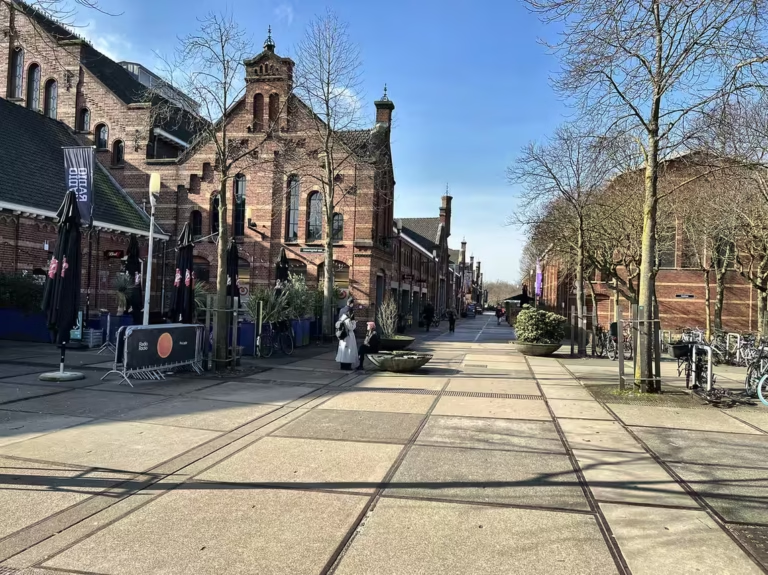
The Westergas complex within the Westerpark Amsterdam is one of the most complete examples of industrial architecture in the Netherlands. Designed by architect Isaac Gosschalk in a neo-Renaissance style, the buildings were intended to be both functional and aesthetically pleasing. The use of red brickwork, ornate details, and large arched windows was characteristic of the era’s pride in industrial progress.
Among the most prominent structures is the Gashouder (Gas Holder). This massive circular building originally served as a storage tank for gas. It features a pillarless interior, which made it an engineering marvel at the time of its construction. Following the decommissioning of the plant, the Gashouder and several surrounding buildings, such as the Zuiveringshal (Purification Hall) and the Ketelhuis (Boiler House), were preserved rather than demolished.
The transformation of these buildings in the late 1990s and early 2000s followed a “culture park” model. This involved cleaning the heavily contaminated soil and repurposing the structures for creative industries, hospitality, and event spaces. The industrial aesthetic has been carefully maintained, with many original features, such as iron roof trusses and brick facades, remaining visible to visitors today.
Tip: The Gashouder building within the Westergasfabriek complex is officially listed in the National Monument Register (Rijksmonumentenregister) under monument number 526756.
Discover Westerpark Amsterdam!
Spatial Design and Nature in the Westerpark
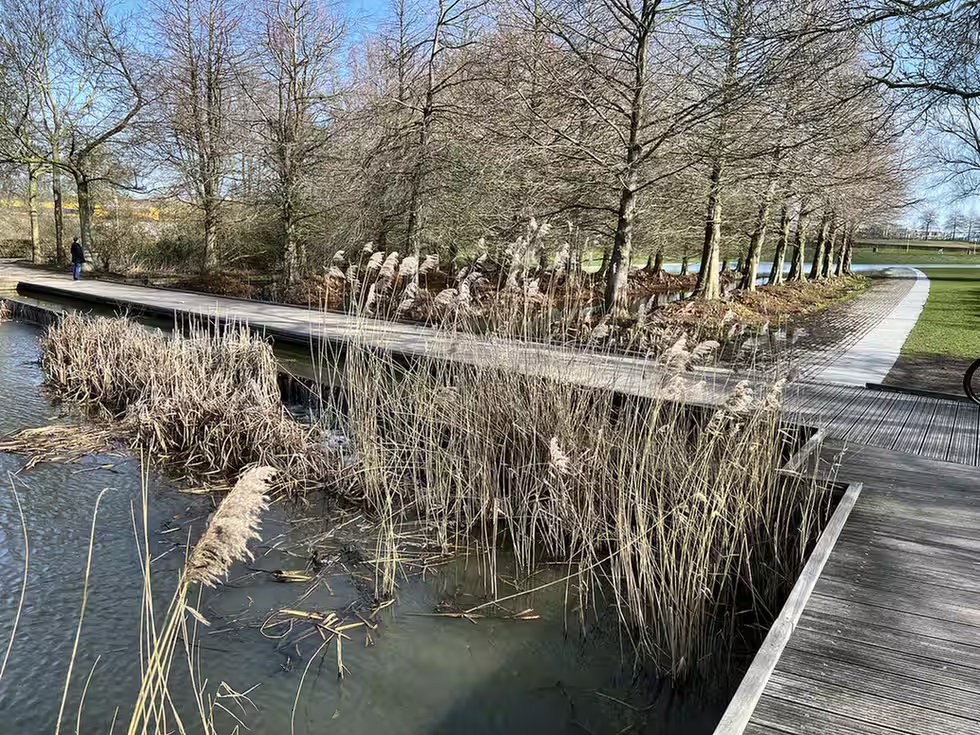
The modern layout of the Westerpark Amsterdam is the result of a significant expansion completed in 2003. Landscape architect Kathryn Gustafson was commissioned to merge the old 19th-century park with the former industrial grounds. Her design introduced a long, linear water feature that runs through the center of the park, symbolizing the cleansing of the site’s industrial past.
The park is characterized by a variety of landscapes. The eastern side retains the classic, wooded feel of the original 1891 park, while the western expansion offers wide open lawns and wetlands. These wetlands are not only decorative but serve an ecological purpose by managing rainwater and providing habitats for local bird species and amphibians. The diversity of flora in the park includes traditional Dutch willow trees as well as more formal horticultural arrangements near the historic buildings.
The Westerpark Amsterdam also serves as a critical link in the Hoofdgroenstructuur (Main Green Structure) of Amsterdam. This policy ensures that green spaces remain connected to allow for biodiversity corridors throughout the city. Because of its size and varied terrain, the park is a favored location for birdwatching and urban nature photography, despite its proximity to the busy city center.

Discover our Amsterdam Classics on Spotify!
Dutch classics about Amsterdam
Cultural Significance and Modern Usage
The Westerpark Amsterdam has evolved into a major cultural hub that hosts international events throughout the year. Because of the large capacity of the Gashouder and the surrounding lawns, the site is a frequent venue for festivals such as the Unseen Photo Fair and various music events. The indoor spaces are utilized for fashion shows, tech conferences, and art exhibitions, cementing the park’s reputation as a creative center.
In addition to large-scale events, the park supports a range of permanent cultural institutions. The Ketelhuis operates as an independent cinema focusing on Dutch and European films, while various ateliers provide workspace for local artists. This mix of temporary events and permanent creative residents ensures that the park remains active during both day and night.
The park’s function as a social space is enhanced by numerous restaurants and bars located within the historic gasworks buildings. These establishments often utilize terrace seating that overlooks the green spaces, creating a seamless transition between the built environment and nature. This integration of hospitality and leisure is a key factor in why the park attracts a wide demographic, from families with children to professionals working in the creative sector.
Tip: Since 2003, the Westerpark Amsterdam has hosted the Sunday Market on the first Sunday of every month, unless an exceptional event occupies the entire Westergas territory.




Notable Architecture and Monumental Status
The architectural value of the Westerpark Amsterdam is formally recognized by the Dutch government. The entire Westergasfabriek site is a protected monumental complex. This status means that any renovations or changes to the buildings must adhere to strict conservation guidelines to preserve the industrial heritage.
One particularly notable building is the Regulateurshuis (Regulator House), which once controlled the pressure of the gas being sent into the city’s network. Its small scale and detailed masonry provide a contrast to the larger production halls. Another significant structure is the Wassertoren (Water Tower), which was essential for the gas production process. The preservation of these technical buildings allows visitors to understand the complete cycle of 19th-century energy production.
The influence of the Amsterdam School style is also visible in some of the later additions to the park and the surrounding residential buildings. This style, known for its expressive use of brick and rounded shapes, complements the earlier neo-Renaissance industrial buildings. The combination of these architectural styles within a single park environment makes the area a significant site for students of urban design and architectural history.
Explore Westerpark Amsterdam like a local
The Westerpark Amsterdam is a significant urban green space and cultural complex located in the western part of the city. This area combined a 19th-century municipal park with the industrial heritage of a former gas factory. Today, it serves as a center for leisure, culture, and nature, offering a diverse range of activities and historical landmarks within its boundaries.
Logistics and Accessibility
Reaching the Westerpark Amsterdam is straightforward due to its central location in the West district. The park is situated approximately 1.5 kilometers from Amsterdam Central Station. For those using public transport, tram line 5 and several bus lines stop at the Van Hallstraat or Westergasfabriek stops, providing direct access to the main entrance.
The park is designed to be highly accessible for pedestrians and cyclists. A major bicycle path runs through the length of the park, connecting the city center with the western suburbs. This path is part of a larger network that encourages carbon-neutral commuting within the city. For visitors arriving by car, there is an underground parking garage located at Haarlemmerweg, though the park itself is a car-free zone to prioritize safety and environmental quality.
Navigating the park is aided by clear signage that directs visitors to the various historic buildings, playgrounds, and nature trails. The park remains open 24 hours a day, although the individual businesses and cultural venues within the Westergas complex have their own specific operating hours. The level terrain makes the entire site accessible for individuals with mobility challenges, ensuring that the park’s historical and natural assets can be enjoyed by everyone.
Take a virtual tour with Google Streetview!
Frequently Asked Questions (FAQ)
What is the best way to get to Westerpark Amsterdam from the city center?
The park is easily accessible by taking bus 21 from Amsterdam Central Station to the Westergasfabriek stop, or by a 15-minute walk from the Jordaan district.
Is there an entrance fee for the Westerpark?
Access to the public park and the outdoor areas of the Westergas complex is free of charge. However, specific events, museums, or the cinema within the park may require a paid ticket.
Are dogs allowed in the Westerpark?
Yes, dogs are allowed in most areas of the park. Some sections are designated as off-leash areas, while in other parts, such as near the playgrounds or the petting zoo, dogs must be kept on a lead.
What was produced at the Westergasfabriek?
The factory produced coal gas, which was used for lighting the streets of Amsterdam and for domestic heating and cooking from 1883 until 1967.
Is the Westerpark Amsterdam suitable for children?
The park includes several facilities for children, including a public petting zoo (Woeste Westen), a water play area, and multiple playgrounds.

Leave a Reply