
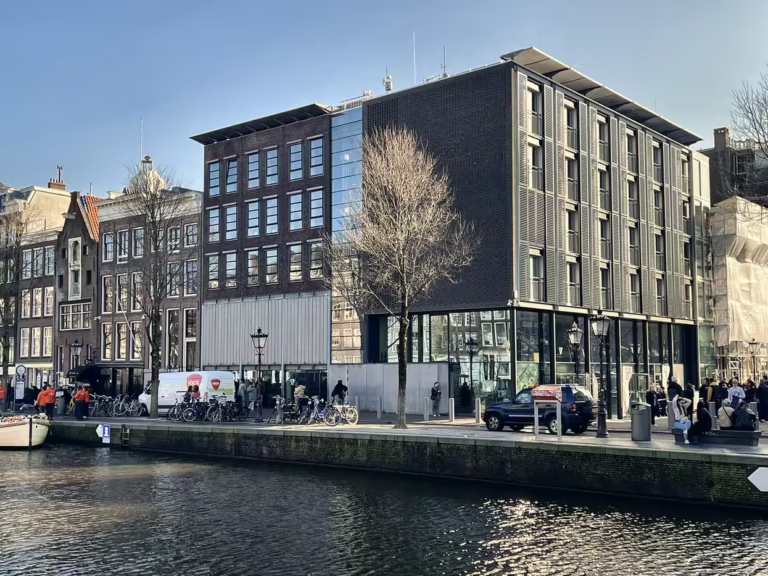
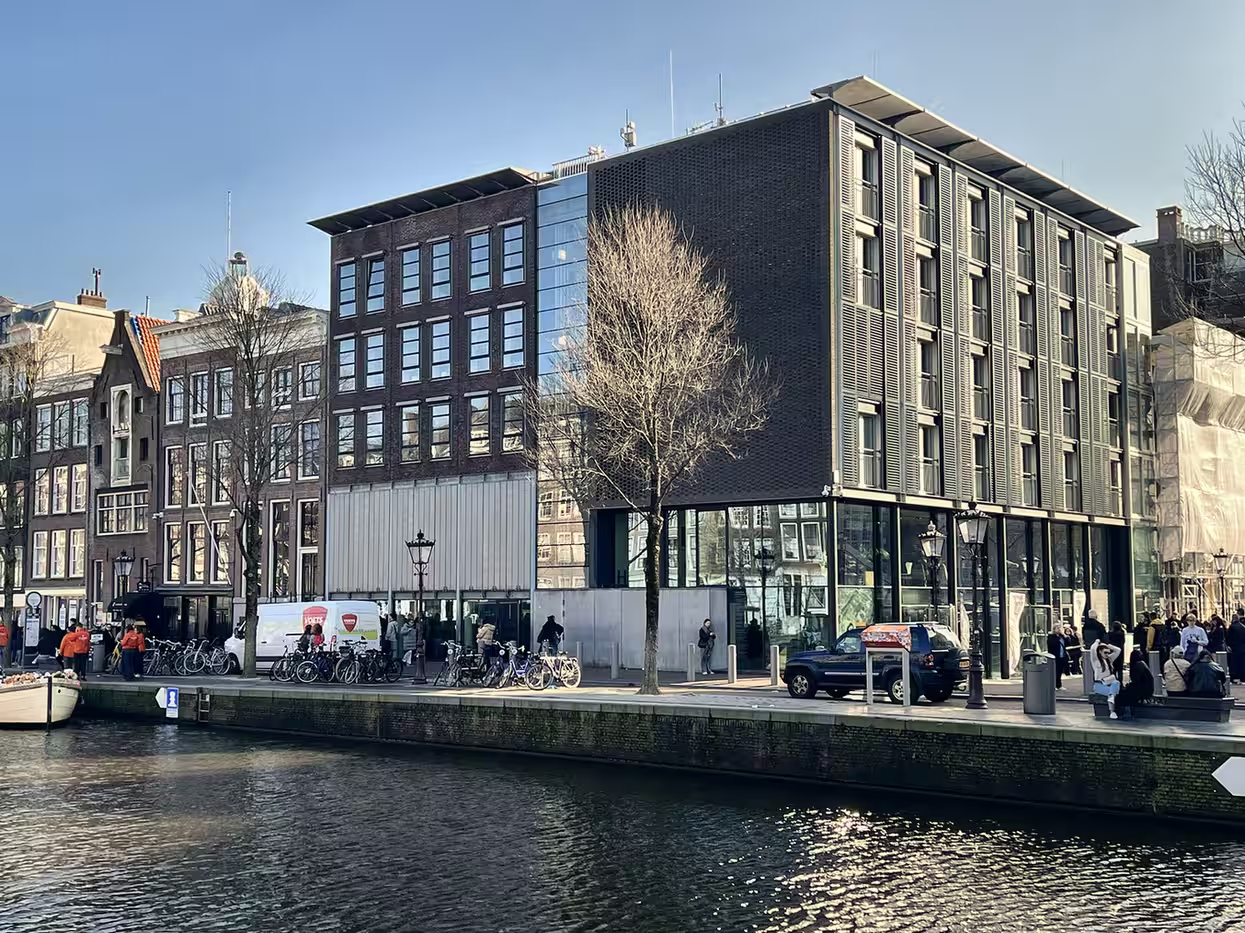
The Anne Frank House is a primary historical site in the Netherlands, serving as a biographical museum and educational center focusing on Anne Frank and the Holocaust. Situated at Prinsengracht 263-267, the museum encompasses the original 17th-century canal house and a modern expansion. For international travelers, the Anne Frank House offers a factual and immersive look at the life of Anne Frank, her family, and the other inhabitants who lived in hiding for 761 days. Since opening in 1960, the institution has preserved the “Secret Annex” in its empty state, following the explicit request of Otto Frank. This guide provides a deep dive into the history of the building, the museum’s contents, and the specific logistical facts required for an efficient visit to the Anne Frank House.
In this blog:
The History of Prinsengracht 263
The building at Prinsengracht 263 was constructed in the mid-17th century, with architectural records placing its origins around 1635. Like many canal houses in Amsterdam from this era, it was divided into a main house (het voorhuis) and a rear annex (het achterhuis). In 1940, Otto Frank moved his company, Opekta—a firm specializing in pectin for jam making—to this specific location. The front part of the house contained the office and warehouse, while the rear annex provided a secluded space hidden from the street view.
The decision to go into hiding was made in July 1942, after Anne’s sister, Margot, received a call-up notice to report to a labor camp. The Frank family moved into the annex, which was later joined by the van Pels family and Fritz Pfeffer. To conceal the entrance to the hiding place, a revolving bookcase was installed at the entrance to the Secret Annex in August 1942. This bookcase, built by Johan Voskuijl, hid the steep stairs leading to the upper floors of the annex, allowing the business in the front house to continue operating while eight people lived in secrecy behind it.
Tip: The Anne Frank House is located at the exact street address of Prinsengracht 263-267, 1016 GV Amsterdam.
How to get there?
Plan my journey

The Residents of the Secret Annex
There were eight people who lived in the Secret Annex between July 6, 1942, and August 4, 1944. These included the Frank family: Otto, Edith, Margot, and Anne. They were joined by Hermann and Auguste van Pels and their son Peter, and later by Fritz Pfeffer. During their time in hiding, they were supported by a group of Otto Frank’s employees: Miep Gies, Bep Voskuijl, Johannes Kleiman, and Victor Kugler. These helpers provided food, clothing, and information at great personal risk.
Life in the annex was characterized by constant silence during the day to avoid detection by workers in the warehouse below. Anne Frank used her diary to document the psychological toll of this confinement and the dynamics between the residents. The period of hiding ended on August 4, 1944, when German security officers and Dutch collaborators raided the building following a tip. The residents were arrested and eventually deported to concentration camps; Otto Frank was the only inhabitant of the annex to survive the war.
Inside Anne Frank House.
Establishing the Museum in 1960
After his return to Amsterdam, Otto Frank worked to publish Anne’s writings, which had been recovered by the helpers. In the mid-1950s, the building at Prinsengracht 263 was in poor condition and faced the threat of demolition. The establishment of the Anne Frank Stichting (Anne Frank Foundation) in 1957 was instrumental in saving the property. The foundation’s objective was to restore the house and transform it into a site for education and remembrance.
The Anne Frank House officially opened as a museum on May 3, 1960. Per Otto Frank’s wishes, the Secret Annex remained empty of furniture to symbolize the loss of those who were taken. Over the years, the museum has expanded to include adjacent buildings to provide space for historical context and educational facilities. While the modern wing handles high visitor volumes and provides historical background, the original canal house remains the central focus of the museum visit.
Tip: The museum officially opened its doors to the public for the first time on May 3, 1960.

Discover our Amsterdam Classics on Spotify!
Dutch classics about Amsterdam
The Museum Experience and Exhibits
The visit to the Anne Frank House is a linear experience that guides visitors through the business premises and into the hiding place. In the warehouse and offices, factual displays and audio guides explain the historical context of the German occupation of the Netherlands. The exhibition details the systematic persecution of the Jewish population and the logistics of the Frank family’s life in hiding.
The revolving bookcase remains in its original position, marking the transition into the Secret Annex. Inside, the rooms are kept in the state Otto Frank requested: empty, yet with the original wall decorations intact. These include the pictures of film stars and the British Royal Family that Anne pasted on the walls of her room. Visitors can also see the maps where Otto Frank tracked the progress of the Allied forces and the pencil marks on the wall that recorded the growth of the children during their two years in hiding.


The Diary of Anne Frank: Physical Artifacts
The final portion of the museum focuses on the diary of Anne Frank. The institution preserves the original red-checkered diary, which is on permanent display. It also houses the “notebooks” and the loose sheets of paper Anne used to rewrite her diary for eventual publication. These documents have a unique international status; the archives of Anne Frank are included in the UNESCO Memory of the World Register. This recognition pertains specifically to the documentary heritage of her writings rather than the building itself.
Preserving these artifacts requires strict environmental controls to protect the paper from light and humidity. The museum provides factual information about the different versions of the diary and how it was translated and published globally. The display also includes other writings by Anne, such as her “Favorite Quotes Book,” which illustrates her intellectual development and her aspirations to become a professional writer and journalist after the war.
Discover the story behind Anne Frank House Amsterdam
The Anne Frank House is a biographical museum and educational center dedicated to Anne Frank and the history of the Holocaust. Located on the Prinsengracht in Amsterdam, it preserves the Secret Annex where she lived in hiding. This blog provides a detailed overview of its history, museum exhibits, and essential practical visitor information.
Location, Transport, and Accessibility
The Anne Frank House is located in the Jordaan district, on the Prinsengracht canal. It is situated near the Westerkerk, whose bells Anne frequently mentioned in her diary. The museum is a 20-minute walk from Amsterdam Central Station. Public transport is a common way to reach the site; tram lines 13 and 17 stop at the Westermarkt station, located approximately 150 meters from the museum entrance.
The historical part of the museum presents challenges for visitors with mobility issues due to the very steep and narrow staircases within the 17th-century canal house. While the modern entrance, shop, and cafe are fully accessible, the Secret Annex is not reachable by wheelchair. To address this, the museum offers a virtual reality experience in the accessible modern wing, allowing visitors who cannot climb the stairs to view a digital reconstruction of the hiding place.
Take a virtual tour with Google Streetview!
Practical Visitor Information and Ticketing
The Anne Frank House operates with a mandatory online ticketing system. Tickets are released in weekly batches via the official website (annefrank.org), usually for dates six weeks in advance. It is a verifiable fact that tickets cannot be purchased at the door. Every ticket is linked to a specific timed entry slot, and visitors enter through the modern entrance on the Westermarkt side of the complex.
Opening hours at the museum vary by season. Typically, the museum is open from 09:00, but closing times can range from 19:00 to 22:00 depending on the time of year and specific holidays; visitors are advised to check the official website for the schedule on their specific date. The museum is closed on Yom Kippur. Photography is not permitted inside the museum to preserve the artifacts and the reflective environment. The museum provides a free audio guide in nine languages, and large bags or luggage are not permitted in the cloakroom due to space constraints.
Tip: Tickets for the Anne Frank House are released in weekly batches via the official website for visits six weeks in advance.
Frequently Asked Questions (FAQ)
How do I get tickets for the Anne Frank House?
Tickets must be purchased online at annefrank.org. They are released weekly for dates six weeks in advance.
Is the museum open every day?
The museum is open daily throughout most of the year, with the exception of Yom Kippur. Opening hours vary by season.
Can I use the Museumkaart?
Yes, the Museumkaart is valid, but you must still book a timed entry slot online and pay a small booking fee.
How long does a visit usually take?
Most visitors spend approximately one hour to 90 minutes in the museum.
Is there a place to store large bags?
No, the museum has limited cloakroom space and cannot accommodate large backpacks or suitcases.
Sources
- Anne Frank Stichting. (2024). Official Website: History, Museum, and Research.
- I amsterdam. (2024). Anne Frank House: Practical Visitor Information.
- Holland.com. (2024). The Anne Frank House in Amsterdam.
- Museum.nl. (2024). Anne Frank Huis: Museum Profile.
- UNESCO. (n.d.). Memory of the World Register: Anne Frank Archives.
- Wikipedia contributors. (2024). Anne Frank House.

Leave a Reply