
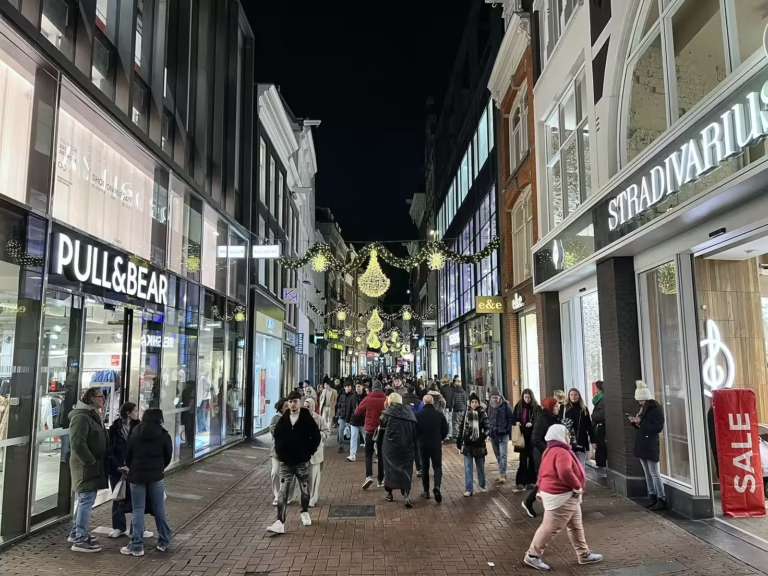
A visit to the center of the Dutch capital inevitably leads to the Kalverstraat, a pedestrianized thoroughfare renowned for its high density of international retail chains. Spanning approximately 750 meters, the Kalverstraat serves as a central artery for the city’s commercial life, connecting major landmarks like Dam Square and the Munttoren. For many, the Kalverstraat is synonymous with modern shopping, yet the street retains deep historical roots that reflect Amsterdam’s growth from a medieval settlement to a global trading hub. This article provides a factual overview of the street’s evolution, current functions, and the notable historical sites integrated into its retail landscape.
In this blog
The Medieval Origins and Naming
The history of the Kalverstraat dates back to the late Middle Ages. Until the 17th century, the street was the site of a specialized market where calves were traded, which gave the street its name (“Kalver” refers to calves). This market was an essential part of Amsterdam’s agricultural economy before the city’s major 17th-century expansions. The street followed the course of the western levee of the Amstel river, providing a natural path for trade and movement within the city’s early defensive walls.
By the 15th century, the Kalverstraat had already begun to transition from a livestock market into a prestigious residential and commercial street. Wealthy merchants and regents built houses here, many of which still exist today behind modernized storefronts. The northern end of the street, near Dam Square, was particularly significant due to its proximity to the city’s administrative heart. This historical layer is still visible in the narrow, deep plots of the buildings, which are characteristic of medieval Amsterdam’s urban planning.
Tip: The street was officially divided from the Nieuwendijk in the year 1391, following the construction of the Dam.
How to get there?
Plan my journey


Retail Significance and Economic Footprint
Today, the Kalverstraat is the most commercially valuable street in the Netherlands. It houses over 150 individual shops, ranging from global fashion giants to specialized electronics and toy retailers. In the Dutch version of the board game Monopoly, the Kalverstraat is the most expensive property, reflecting its real-world status as a premium retail location. Rental prices on this street are among the highest in Northern Europe, often exceeding 2,500 euros per square meter per year.
The footfall statistics for the Kalverstraat are significant for urban planning. On an average Saturday, the street can accommodate between 50,000 and 100,000 pedestrians. Because it is a pedestrian-only zone, the entire width of the street is used for foot traffic, necessitating strict regulations for delivery vehicles, which are only permitted during early morning windows. This high density of consumers makes the Kalverstraat a critical location for flagship stores of brands such as H&M, Zara, and Nike.
Tip: Delivery vehicles are only permitted to enter the Kalverstraat between 07:00 and 11:00 on weekdays to ensure pedestrian safety.
Kalverstraat Shopping Street
Architectural Highlights and Hidden Landmarks
Despite the dominance of modern retail signage, the Kalverstraat contains several significant architectural sites. One of the most notable is the Amsterdam Museum, which is housed in the former Burgerweeshuis (City Orphanage). The entrance to the museum’s courtyard is located at Kalverstraat 92. This complex features architecture from the 17th century and serves as a quiet enclave away from the shopping crowds. The museum’s presence on the street highlights the integration of high-culture institutions within commercial districts.
Another major landmark is the Begijnhof, one of the oldest inner courts in Amsterdam. While the main tourist entrance is located via the Spui, there is a historical gate leading to the Begijnhof situated at the Kalverstraat. Additionally, the street features the Petrus en Pauluskerk, also known as “De Papegaai” (The Parrot). This Neo-Gothic church, built in 1848, is accessible through a narrow facade that blends in with the surrounding shops, representing the “hidden churches” tradition of the Reformation era.
Tip: The official monument registration number for the entrance gate of the Amsterdam Museum at Kalverstraat 92 is 2212.

Running through the historic city center, the busy Kalverstraat is one of the most famous and busiest shopping streets in Amsterdam, connecting Dam Square with the Muntplein. A surprising fact is that the street’s name comes from the calves that were once driven through this area on their way to the medieval cattle market outside the city walls.
The Miracle of Amsterdam and Religious History
The Kalverstraat is closely linked to the “Miracle of Amsterdam,” a religious event that occurred in 1345. According to historical accounts, a dying man spat out a communion wafer, which was then thrown into a fire but remained unconsumed by the flames. This event led to the construction of the Heilige Stede (Holy Site), a chapel located between the Kalverstraat and the Rokin. For centuries, this made the street a destination for pilgrims from all over Europe.
The annual Stille Omgang (Silent Procession) still takes place in March to commemorate this miracle. Thousands of participants walk a route that includes the Kalverstraat in total silence. Although the original chapel was demolished in 1908, the religious significance of the area remains a part of the city’s cultural heritage. This annual event demonstrates how historical traditions continue to interact with the modern, secular environment of the shopping street.


Cultural Representations and Media
As a central location in Amsterdam, the Kalverstraat has appeared in numerous films, documentaries, and literary works. It is often used as a visual shorthand for the bustle of urban life in the Netherlands. In Dutch literature, the street is frequently mentioned in the works of authors such as Multatuli and Lodewijk van Deyssel, who described the social dynamics of the street in the 19th century.
In contemporary media, the Kalverstraat is a frequent subject of economic news reports, particularly regarding retail trends and the shift toward e-commerce. It has also been featured in international travel programs, such as those produced by Rick Steves, highlighting it as a must-visit for travelers interested in the Dutch retail experience. The street’s iconic status makes it a primary location for news crews reporting on national holidays or major public events centered around Dam Square.

Shop Till You Drop: Kalverstraat, Amsterdam’s Best Shopping
The Kalverstraat is the most visited shopping street in the Netherlands, located in the heart of Amsterdam. Stretching from Dam Square to Muntplein, it has a history dating back to the 14th century. This blog examines its medieval origins, modern retail significance, and the architectural landmarks that define its unique character.
Practical Access and Visitor Information
Accessing the Kalverstraat is convenient due to its proximity to major transport hubs. From Amsterdam Central Station, it is a 10-minute walk down the Damrak. Most of the city’s tram lines stop at either Dam Square or Spui, both of which provide immediate access to the street. Because the street is narrow and prone to crowding, visitors often use the parallel Rokin as a faster alternative for moving between the northern and southern parts of the city center.
The shopping hours on the Kalverstraat are standardized. Most stores are open daily from 10:00 to 19:00, with extended hours on Thursdays for “koopavond” (shopping night), when many shops remain open until 21:00. On Sundays, the street remains active, with shops typically operating from 12:00 to 18:00. Public facilities, including toilets and lockers, are available in the larger department stores near Dam Square or in the Kalverpassage at the southern end of the street.
Take a virtual tour with Google Streetview!
Frequently Asked Questions (FAQ)
What is the best time to visit the Kalverstraat to avoid crowds?
The street is least crowded immediately after opening at 10:00 on weekday mornings or during the early evening hours before closing.
Are there historical buildings I can visit on the Kalverstraat?
Yes, the Amsterdam Museum (No. 92) and the “De Papegaai” church (No. 58) are significant historical sites located directly on the street.
Is the Kalverstraat accessible for wheelchairs?
Yes, the street is flat and paved with cobblestones that are generally well-maintained, and it is a pedestrian-only zone.
Where does the Kalverstraat start and end?
It starts at the southern corner of Dam Square and ends at the Muntplein, near the Munttoren.
What was the original purpose of the Kalverstraat?
It originated as a cattle market, specifically for calves, which is how it acquired its name in the 14th century.
Sources
- Amsterdam Museum. (2024). History of the Burgerweeshuis.
- City of Amsterdam (Gemeente Amsterdam). (2024). Traffic and Pedestrian Regulations: Kalverstraat.
- Historisch Nieuwsblad. (2024). De geschiedenis van de Amsterdamse Kalverstraat.
- Rijksdienst voor het Cultureel Erfgoed. (n.d.). Monumentnummer: 2212 – Kalverstraat 92 Amsterdam.
- Stichting Stille Omgang. (2024). The Miracle of Amsterdam and the Procession Route.
- Wikipedia contributors. (2024). Kalverstraat.

Leave a Reply