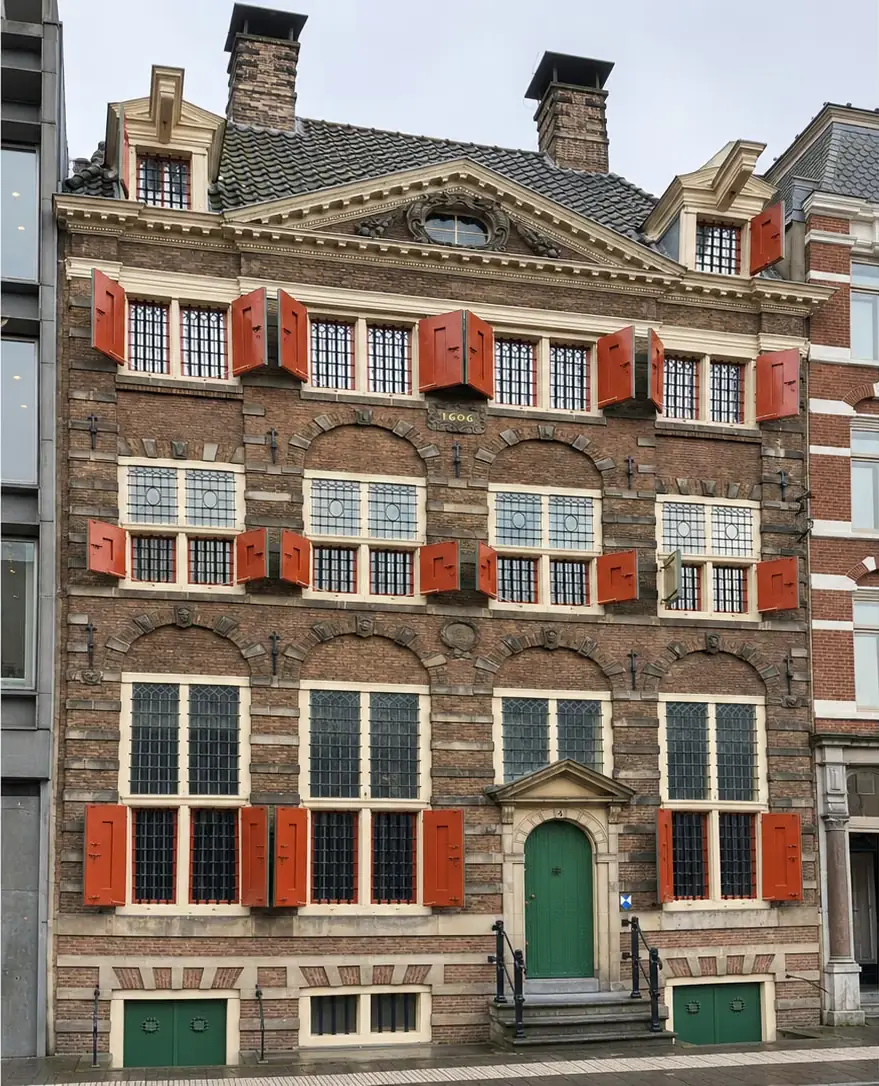




At the Rembrandt House Museum in Amsterdam, you can stand in the room where Rembrandt painted. The museum occupies his former home at Jodenbreestraat 4, near Waterlooplein and Nieuwmarkt. A modern entrance leads into the historic house, where the kitchen, reception rooms, studio and cabinet of curiosities help explain how a seventeenth-century artist worked. The furniture and objects are a reconstruction informed by records of the household.
The visit is particularly rewarding if you want to understand how a painting or an etching was made. There are live demonstrations on a changing timetable, and the museum usually displays some original Rembrandt prints. Set aside roughly 60 to 90 minutes as a planning estimate, with extra time if you want to linger in a temporary exhibition. Check the museum’s access guide if stairs are a concern.
This guide follows the visit from the street into the studio. It explains which ticket includes the multimedia guide, how to find a demonstration, and where to see more Rembrandt work after you leave.
Visitor tip: Look up at the historic façade before entering the modern part of the museum. It is easier to picture the front rooms once you have seen how the windows are arranged.
Contents
What to expect at the Rembrandt House Museum
Rembrandt lived and worked in the house between 1639 and 1658. Rooms across different levels show the overlap between a private household and a workplace. The museum’s room guide identifies the living and sleeping spaces, workshop, print room and collecting room. Take the historic route at your own pace, then use the modern wing for temporary exhibitions and the explanation of how the house was researched and furnished.
This is one stop in a wider story about art in Amsterdam. Go to the Rijksmuseum for major Rembrandt paintings such as The Night Watch. At the house, pay attention to the size of the studio, the position of its windows and the tools. If you are fitting both museums into a trip, leave room between reservations. Our three-day Amsterdam itinerary helps place the museum in a visit to the old centre.
Visitor tip: Check the demonstration board as you arrive. Booking a museum time gives you access to the house, and the day’s programme tells you when to reach the right room.
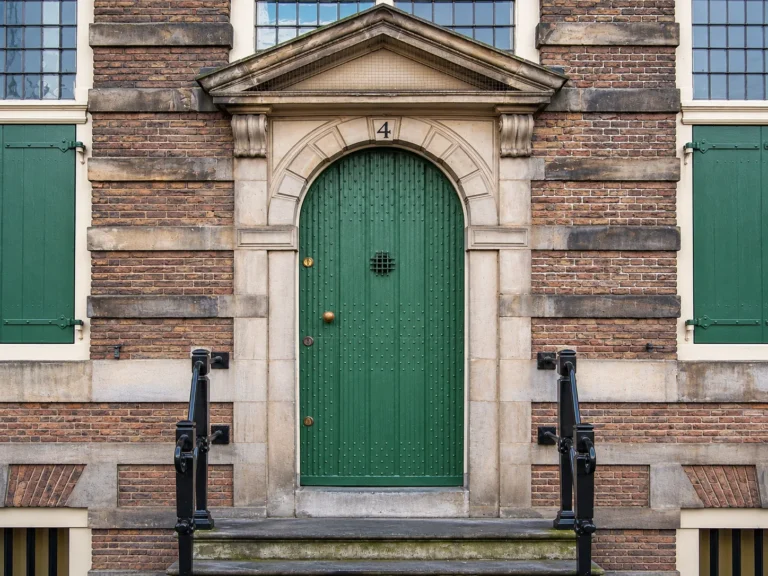
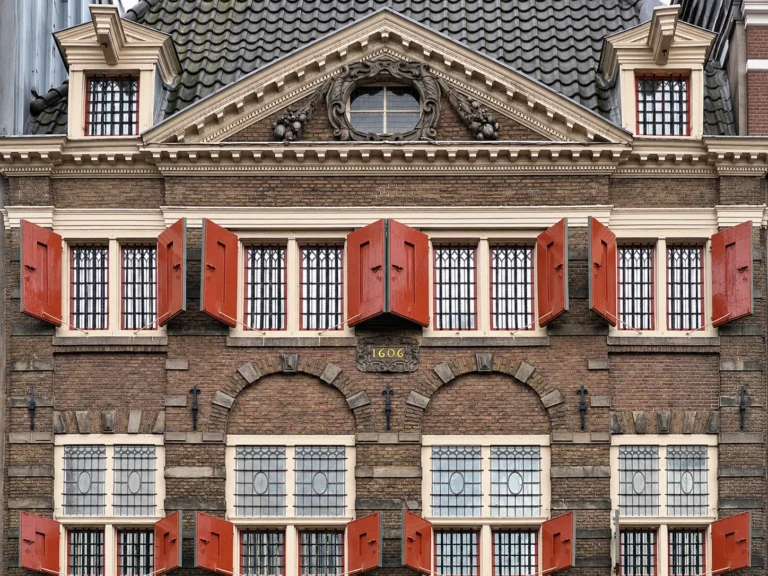
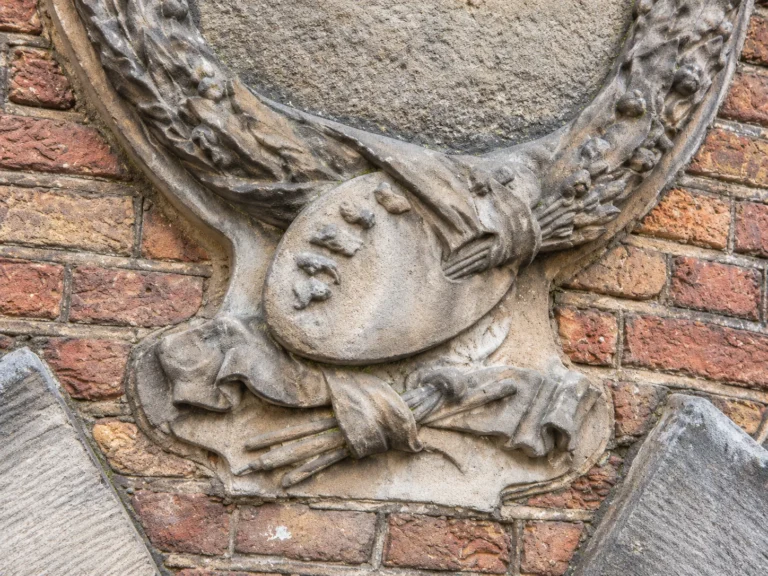
Image credits
Illustrations adapted from the photographs and artworks credited here.
- Rembrandt House Museum façade with red shutters and green door. Chabe01 · CC BY-SA 4.0 → CC BY-SA 4.0
- Arched green door in a pale stone surround at the Rembrandt House. Spider · CC BY-SA 3.0 → CC BY-SA 4.0
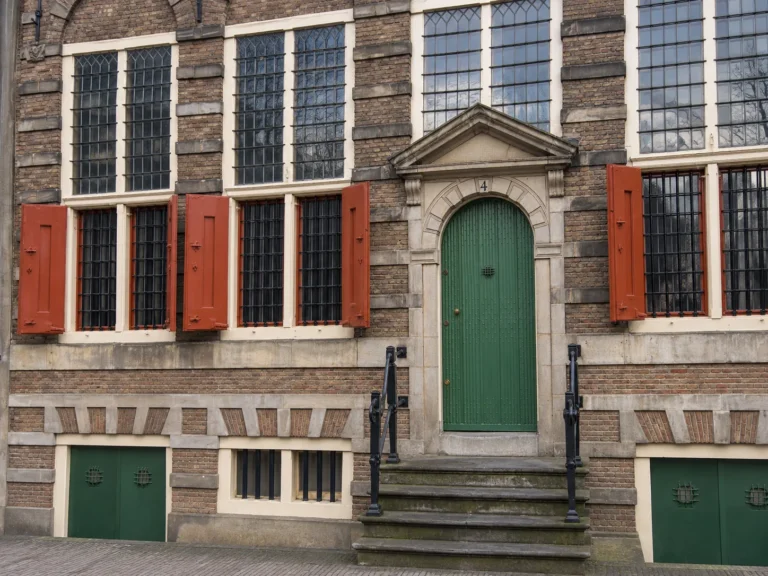
- Red shutters, leaded windows and triangular pediment. Chabe01 · CC BY-SA 4.0 → CC BY-SA 4.0
- Stone relief in the brick façade of the Rembrandt House. Spider · CC BY-SA 3.0 → CC BY-SA 4.0
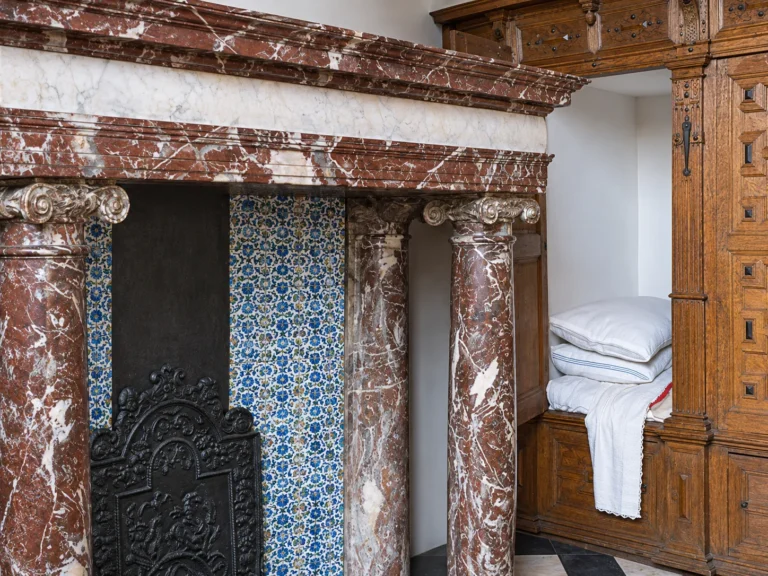
- Marbled fireplace surround and blue tiles in the Rembrandt House. Remi Mathis · CC BY-SA 3.0 → CC BY-SA 4.0
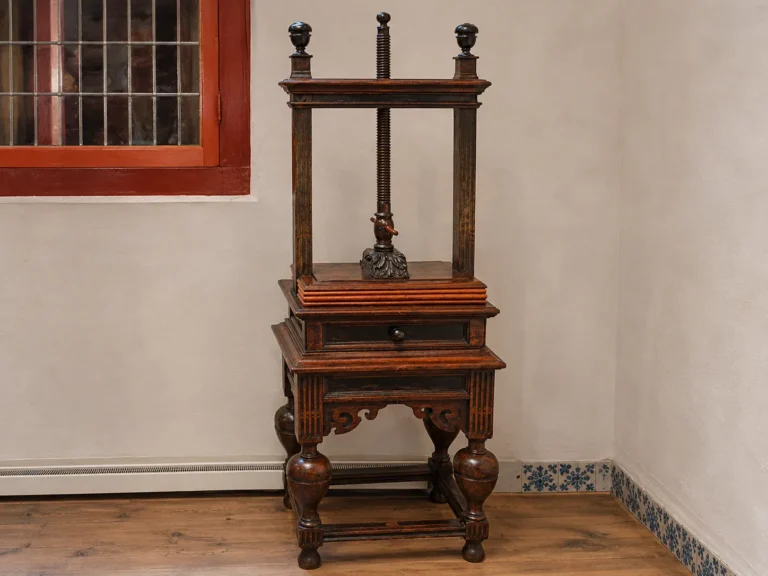
- Wooden screw press on a plank floor in the Rembrandt House. Remi Mathis · CC BY-SA 3.0 → CC BY-SA 4.0
- Leaded house windows surrounded by brick and pale stone bands. Chabe01 · CC BY-SA 4.0 → CC BY-SA 4.0
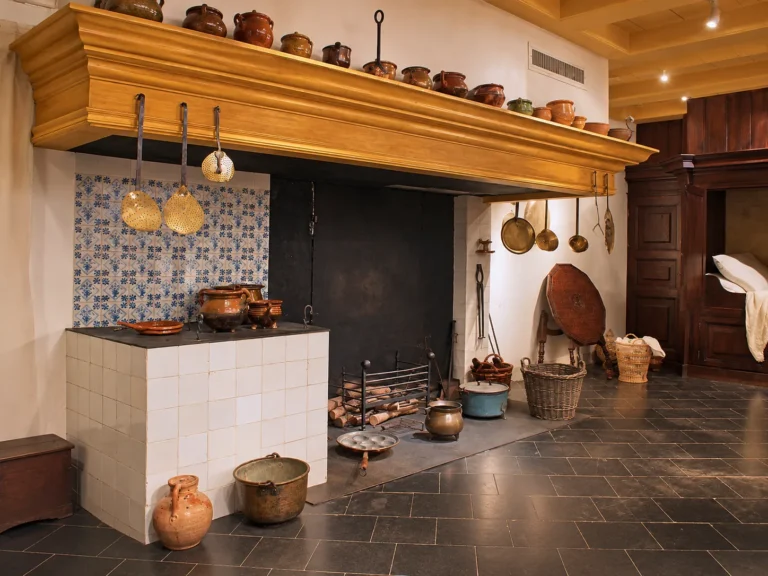
- Reconstructed kitchen with a tiled hearth and hanging brass utensils. Hajotthu · CC BY 3.0 → CC BY-SA 4.0
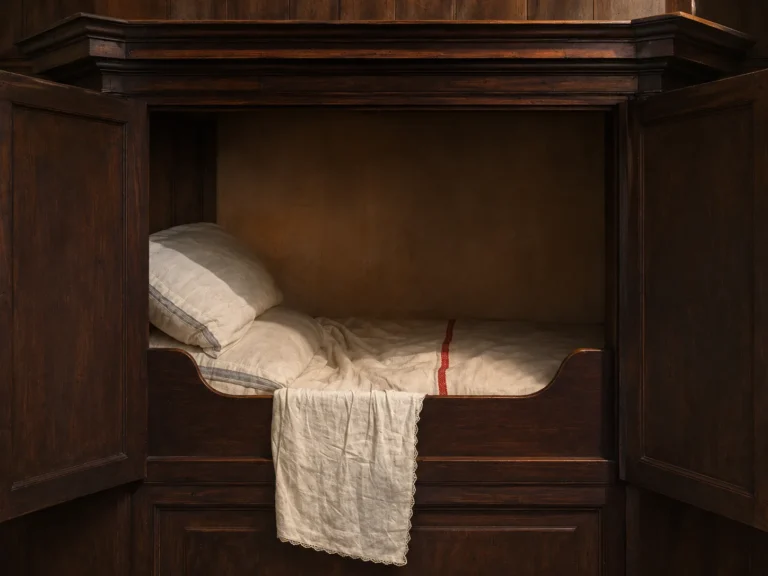
- White linen on a dark wooden box bed. Remi Mathis · CC BY-SA 3.0 → CC BY-SA 4.0
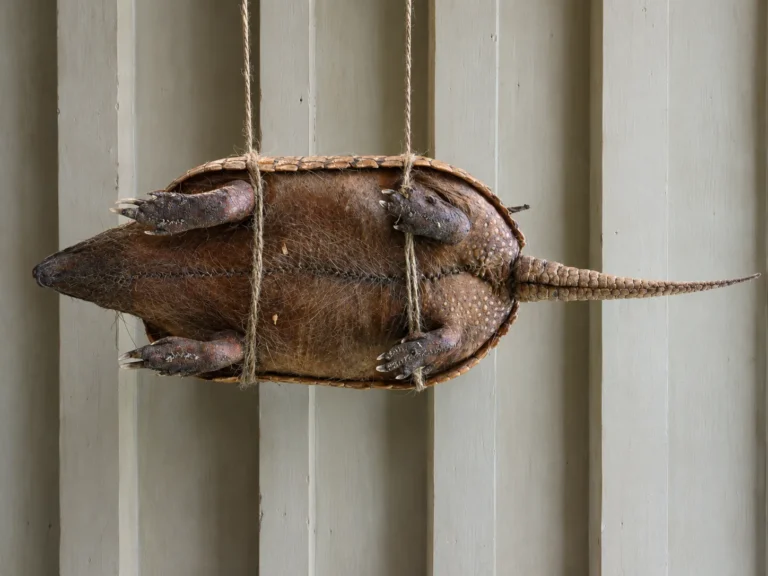
- Suspended armadillo specimen from the Rembrandt House collection. Remi Mathis · CC BY-SA 3.0 → CC BY-SA 4.0
How Rembrandt’s home became a museum
The house dates from 1606. The Dutch monuments register describes its four-window façade and the change from a stepped gable to an upper storey with a pediment. Rembrandt bought the house in 1639, when portrait commissions and the market for his prints had made him a well-known artist. The location in Jodenbreestraat put him in the heart of a growing city. Nearby De Waag and the streets around Nieuwmarkt help make that setting tangible.
His finances deteriorated, and a detailed list of his belongings was drawn up in 1656 during the insolvency proceedings. He left the house in 1658. According to the museum’s biography, the inventory is one reason the house can be furnished to reflect the studio and household of that period. It documents belongings room by room, giving researchers clues to how the family and the artist used their space.
The museum opened in 1911 after a restoration led by Karel de Bazel. Curators and architectural historians have reconsidered the appearance of the rooms as new evidence emerged. An independent study of the museum’s early history explains how ideas about restoring an artist’s home have changed. The sequence puts the old building, the reconstructed furnishings and the displays of original art into context.
Visitor tip: Pause at the street corner before you go. The change from the broad Jodenbreestraat to the older streets around Nieuwmarkt is a useful way to begin a walk after the museum.
Five things to look for inside the house
1. An inventory explains how the rooms were furnished
The list compiled in 1656 is one of the most revealing objects connected with the house. It describes paintings, furniture, tools and other property in the rooms where they were found. The museum’s account of the insolvency links this document to the way the historic rooms are shown today. For a visitor, the useful insight is that one list can establish relationships between objects. A thing listed in a studio and the same thing listed in a bedroom would point to different ways of using it.
Imagine trying to furnish a room from a list that supplies names and locations without photographs. You can work out what sorts of objects a household had, but the entry may leave the shape, material or exact position uncertain. Look at the furniture, paintings and practical objects as a group, then visit the Epilogue room to see how the museum explains its decisions. It is a rare chance to compare what stands in front of you with the archival evidence that made the display possible.
Visitor tip: Save a few minutes for the Epilogue room. The inventory is much easier to make sense of after you have walked through the reconstructed spaces.
2. The painter’s studio was a working room
The museum’s room guide identifies the large painting studio as the place where Rembrandt made paintings. Notice how daylight enters the room and how far an easel can stand from the windows. The direction and strength of light affect a painter’s choices about the sitter, the canvas and the palette. The studio makes those decisions easier to imagine on a real scale. Try looking from the entrance and then from a point nearer the window, when the visitor route permits it.
On days with a painting demonstration, an educator explains how paint could be made in the seventeenth century. Mixing pigments and a binder was part of preparing to work. Use the demonstration programme to see whether the session you can catch is about paint or etching. Once you see colour being prepared, it is easier to think about what lies behind a finished surface. Bring the comparison to the Rijksmuseum if time allows.
Visitor tip: Stand clear of the doorway when the studio is busy. You can follow the demonstration and still leave enough space for people moving through the house.
3. A printing press changes what one image can become
An etching starts with a metal plate. The artist draws through a protective ground to expose the metal along the lines. Acid bites those lines into the plate. When ink remains in the grooves and the plate passes through a press with paper, the ink transfers to the sheet. The result is a print from which further impressions can be taken. The museum uses its etching demonstrations to show how the image survives the move from plate to paper.
Watch for a relationship between a small hand movement and the finished image. Tiny lines can change how a face is lit or how a piece of cloth seems to fold. At the press, wiping ink and placing the paper are visible stages. In a display case, you can examine the fine lines that those actions produce. If the print room has a Rembrandt you recognise, give it time before you move on. A print can reward as much attention as the larger canvases people associate with him.
Visitor tip: Look at the centre of the impression and at the blank paper around it. When a plate mark is visible, it shows where the paper was pressed against the edges.
Inside the Rembrandt House Museum
4. The box bed and kitchen reveal the household
A narrow box bed is one of the clearest signs that the house worked as a home. The museum’s account of the rooms describes the space where Rembrandt and Saskia sat by the fire and slept. The arrangement brings sitting, heating and sleeping into a single room. Look at what the bed takes up in the room and at what the rest of the floor still had to accommodate. Domestic actions that often happen in separate rooms today can be easier to imagine there.
The kitchen offers a second perspective. Its hearth and utensils explain the work that took place below or away from the artist’s main workrooms. Trying to see the house as a household rather than a portrait of one person also changes what you notice about its plan. The stairs, doorways and landings connect the spaces where food, heat, storage, painting and visitors had to be managed. The city’s canal-house architecture offers other examples of how narrow urban buildings used their height.
Visitor tip: At a quiet point on the stairs, note how tightly the different rooms fit. Keep moving whenever people are passing.
5. Objects in the cabinet were useful things to look at
Rembrandt’s collecting room puts different materials in a small space. The museum’s description of the house connects this room with objects including natural specimens and works of art. A shell, bone or animal specimen gives an artist a textured surface and unusual outline to study. Looking at them calls for a different sort of attention from looking at a portrait. Try to see some of the objects as individual forms, even when they are presented together on shelves.
A collection like this also points to networks beyond Amsterdam. Goods, prints and specimens circulated through trade, and artists could encounter objects that came from much farther away than they did. A visitor can use the collecting room as a starting point for thinking about those exchanges. The National Maritime Museum is a relevant second stop if that side of the visit interests you, while the Hortus Botanicus offers a different way to consider collecting and studying the natural world.
Visitor tip: Choose one small object and follow its outline with your eyes. Then see whether a strong shadow or reflected light makes it appear different from another point in the room.
Street View on Jodenbreestraat
Open the panorama in Google Maps
Ten practical tips for visiting
- Reserve a start time. Check the museum’s current ticket information before you travel. The booking panel on this page offers the Rembrandt House Museum ticket with multimedia guide.
- Use the museum entrance at Jodenbreestraat 4. From Amsterdam Centraal, Waterlooplein is a useful metro stop. Check the GVB journey planner for your actual route.
- Pick a slot that suits the demonstration. Check the day’s official programme for the subject and timing. A late ticket may suit a house visit better than a demonstration.
- Check when the museum closes on your date. It opens at 10.00 on regular opening days. See the opening hours and exceptions for the closing time on your chosen date.
- Allow about 60 to 90 minutes. This is a practical allowance for the house, multimedia guide and a short look at the displays. Add time for a demonstration or full temporary exhibition.
- Plan around the historic stairs. The accessibility information distinguishes the modern, lift-served wing from the stepped historic house. Ask staff about the virtual tour if you need an alternative.
- Ask about bags and photography if unsure. Check the visitor terms, leave large bags as directed and follow restrictions on photographing works or using a flash.
- Use the multimedia guide deliberately. Choose a language and listen to the stops that interest you. The museum lists a separate family route in its ticket information.
- Continue towards Nieuwmarkt or the Plantage. For a short walk, visit De Waag. To make a family day of it, continue towards NEMO or ARTIS, leaving time between activities.
- Choose your second Rembrandt stop by interest. For paintings, plan time at the Rijksmuseum. For the city the artist knew, walk towards Dam Square, or use our canal cruise guide if you would rather see the historic water routes from a boat.
Frequently asked questions
Is the Rembrandt House Museum the house Rembrandt actually lived in?
Yes. Rembrandt bought the historic house at Jodenbreestraat 4 in 1639 and lived and worked there until 1658. The museum has restored and furnished its rooms with the help of architectural research and documents including the 1656 inventory. You see the house where he worked, alongside later furnishings and displays that explain how the household may have looked.
Is a painting or etching demonstration included in the ticket?
Museum admission includes access to the regular demonstrations. The museum runs painting or etching sessions according to its published programme. Confirm the subject and timetable for your chosen date, then ask where to wait on arrival. A separately bookable workshop or private guided session is a different experience. Give yourself time beforehand to find the room in the historic house.
How long should I allow at the Rembrandt House Museum?
Allow about 60 to 90 minutes for a first visit. That gives you a practical amount of time for the historic rooms, selected stops on the multimedia guide and a look at some of the prints. If you want to see a demonstration or spend longer in a temporary exhibition, allow more time before your next booking.
Can I visit with a wheelchair or with limited mobility?
The modern wing has a lift and accessible facilities. The original house has steep stairs and narrow passages, so wheelchair access differs between the two parts. Check the museum’s accessibility page for the current route and contact its staff if you need advice. The museum also offers a virtual way to see the historic rooms, which can complement an on-site visit to the modern wing.
Where can I see The Night Watch after visiting the house?
The Night Watch is at the Rijksmuseum. The Rembrandt House Museum is where Rembrandt lived while he was producing work of this period and is a place to see original prints and learn about his methods. Booking both museums gives you two distinct experiences. Check the Rijksmuseum’s gallery information before setting out if the painting is the main reason for your visit.
Sources
Visitor information checked on 22 November 2026. The images are illustrations based on credited photographic references.
- Rembrandt House Museum · The rooms
- Rembrandt House Museum · Opening hours and tickets
- Rembrandt House Museum · Accessibility
- Rembrandt House Museum · Demonstrations
- Rembrandt House Museum · Rembrandt van Rijn
- Rembrandt House Museum · Visitor terms
- Rijksdienst voor het Cultureel Erfgoed · Jodenbreestraat 4
- Journal of the History of Collections · The origins of the Rembrandt House Museum
- GVB · Journey planner